

In short
Ridge tiles come loose because the mortar bedding them has cracked and let go; mortar alone was never a permanent fixing. Since the 2014 revision of BS 5534, ridge and hip tiles have to be mechanically fixed as well, so the proper repair is a dry ridge system that clamps every tile to a batten. Repointing puts the same failure back for another few winters.
This is a job for our Dry Ridge & Dry Verge service.
Why the mortar fails
Sand-and-cement mortar shrinks as it cures, cracks when the roof moves, and is only as strong as the mix on the day. Marley's guide to fixing ridge and hip tiles says several factors can cause mortar to fail, often within the first few years, and that the 2014 revision of BS 5534 made clear the tensile strength of mortar alone could no longer be relied on to hold ridge tiles. Redland's guide to the same standard quotes the NHBC finding that nearly two thirds of roofing claims against its Buildmark warranty were related to mortar failure.
The fens make it worse. There is very little between a ridge in Holbeach or Crowland and the wind coming off the Wash, and a ridge tile with cracked bedding is a sail. We see them lifted, slid down the slope and, after a bad night, in the front garden.
Repoint or replace: what the standard says
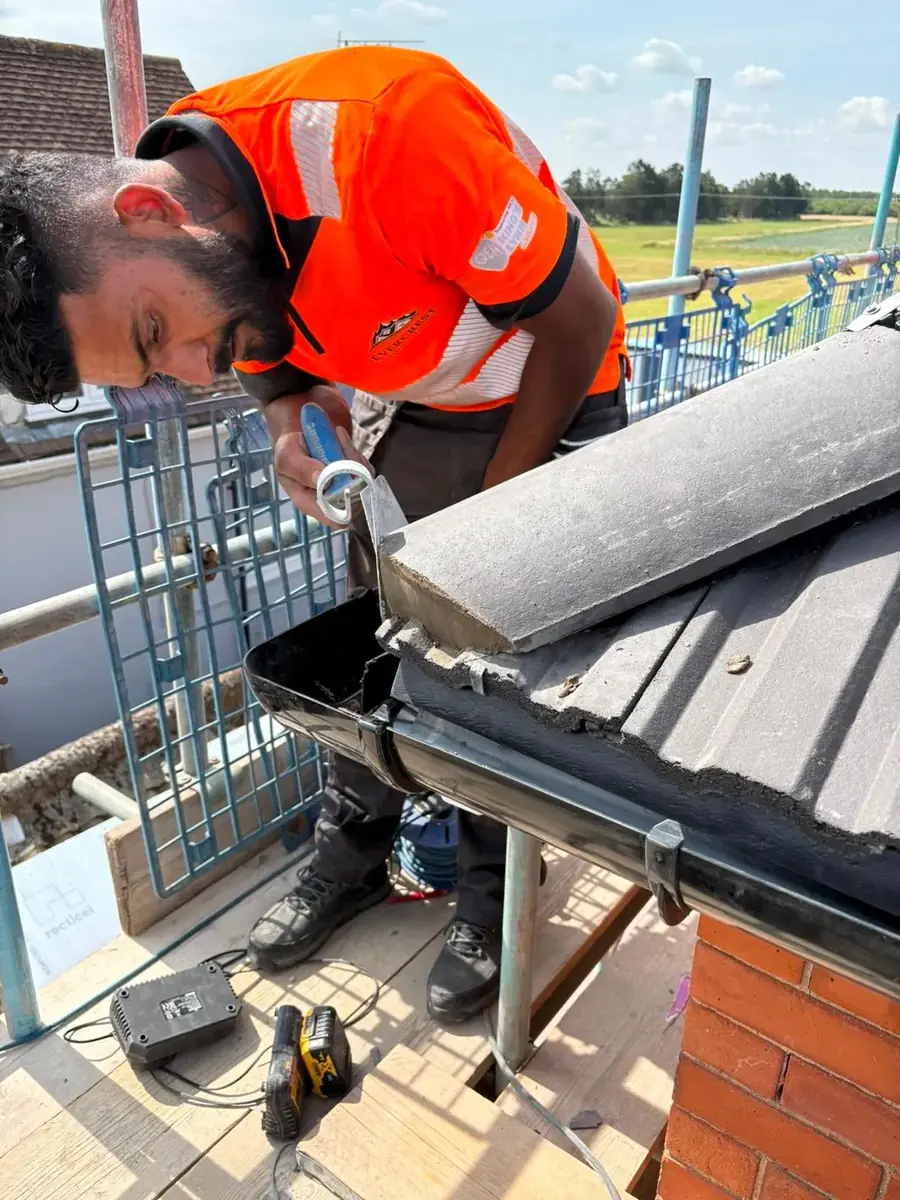
Repointing is allowed, but it is no longer enough on its own. Redland's guide sets it out: if mortar is used, the ridges and hips must also be mechanically fixed, which means a ridge batten fixed to the rafters, a membrane to protect it, and a fixing through every tile. Once you are doing all of that, a dry ridge kit does the same job with the fixings included and nothing to repoint later. That is what we fit.
| Option | What holds the tile | What happens next |
|---|---|---|
| Repoint only | New mortar, no mechanical fixing | Not compliant with BS 5534 as a fixing; the mortar cracks again |
| Rebed with fixings | Mortar plus batten, membrane and screws | Compliant, but the mortar still weathers and needs repointing |
| Dry ridge system | Batten, clamps and screws, no mortar | Compliant, ventilated at the ridge, nothing to maintain |
What a dry ridge involves
- We lift the existing ridge tiles and clear the old mortar off the top course of tiles.
- A ridge batten goes on brackets fixed to the rafters, with a roll-out membrane that seals the ridge and lets the roof breathe.
- Each ridge tile is refitted and clamped through to the batten. The verges get the same treatment if we are asked to do them together, which is usually the sensible time.
Checkatrade's 2026 roof repair guide lists dry ridge at £50 to £70 per metre and dry hip at £70 to £100 per metre, excluding access. On a typical semi in Spalding the price is set more by the scaffold than the ridge itself, which is why we would rather do the ridge, hips and verges in one visit than come back three times.